First International Workshop on
Knowledge Graphs
for Health (KG4Health)
Ottawa, July 10th, 2026
co-located with 24th International Conference on Artificial Intelligence in Medicine (AIME) - 2026
Call for paper
About The KG4Health Workshop
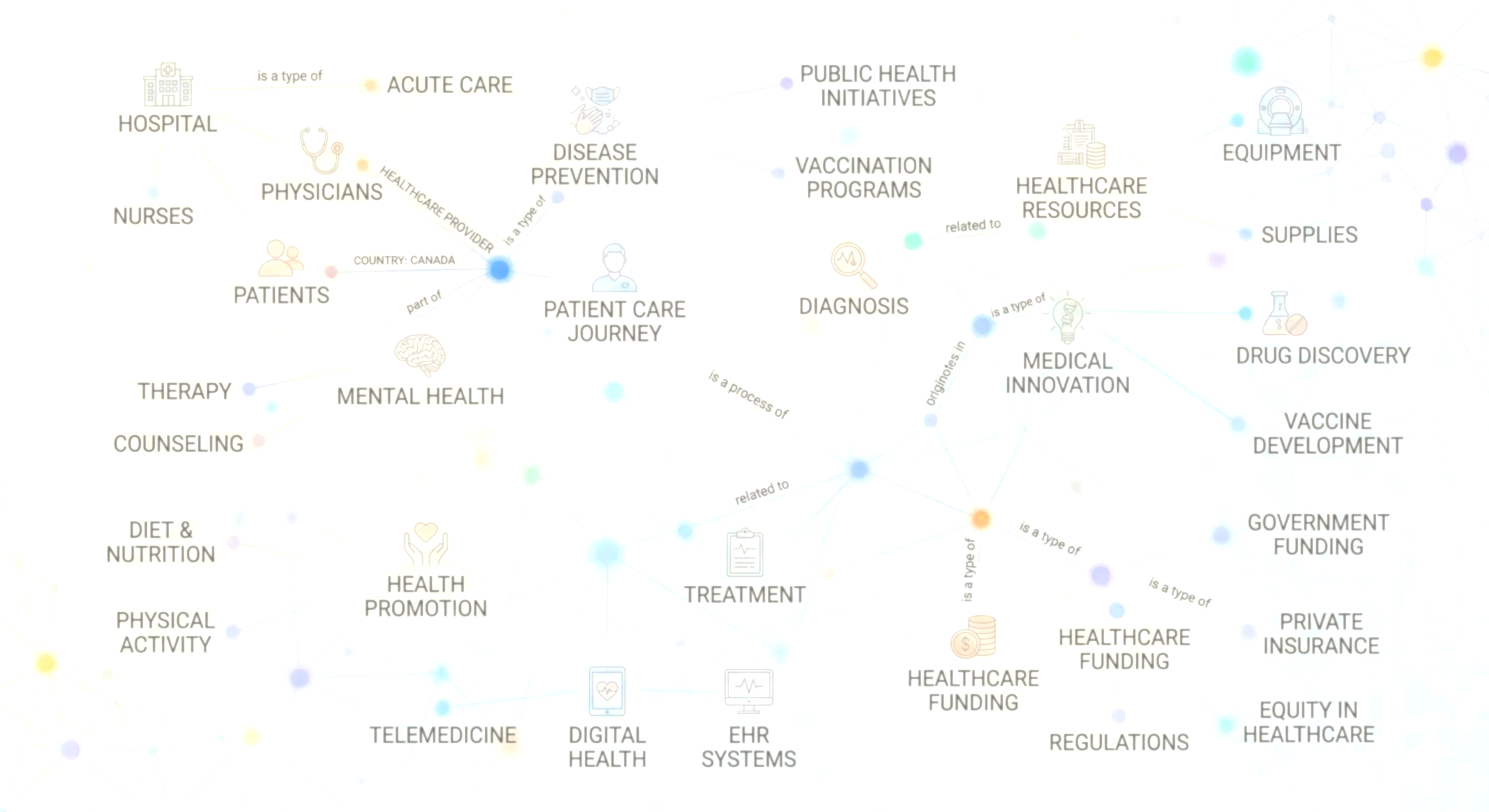
The KG4Health workshop addresses the critical intersection of Knowledge Graphs (KGs) and Artificial Intelligence in the biomedical and healthcare domain.
Where
University of Ottawa (uOttawa), Canada
When
Friday
July 10th, 2026
Call For Paper
The KG4Health workshop addresses the critical intersection of Knowledge Graphs (KGs) and Artificial Intelligence in the biomedical and healthcare domain. While modern AI models (i.e., Generative AI) have shown immense potential in processing healthcare data, clinical text, and biomedical information issues regarding factual accuracy, explainability, and data siloization persist. Knowledge Graphs provide a structured, interpretable foundation that can ground AI models in established medical truths. We welcome computer scientists, medical informaticians, and clinicians to submit their late-breaking results, demos, or position statements via OpenReview to join this high-intensity, half-day dialogue on the future of evidence-based, explainable medical AI. We invite submissions on themes including, but not limited to:
- KG-LLM Integration: Methods for embedding KGs into LLMs to enhance factual grounding and reasoning in medical applications.
- Neuro-symbolic AI: Combining LLMs with KGs (e.g., Retrieval-Augmented Generation - RAG) for medical QA.
- KG Construction & Enrichment: Automated extraction of medical entities/relations from clinical notes and literature.
- Interoperability: Mapping KGs to standard ontologies (SNOMED-CT, UMLS, FHIR).
- Explainable AI (XAI): Using graph paths to provide the "why" behind AI-driven clinical predictions.
- Medical Applications of KG: Drug repurposing, rare disease diagnosis, and personalized treatment pathways.
Motivation
The rapid adoption of AI in medicine and healthcare has highlighted a fundamental "trust gap." While these models are linguistically proficient, they lack an inherent mechanism for factual verification, which can lead to plausible and sometimes dangerous medical hallucinations. AIME participants are increasingly focused on moving AI from experimental environments to high-stakes clinical settings where precision is non-negotiable. Knowledge Graphs (KG) offer the necessary structural scaffolding to ground these generative models in evidence-based medicine, ensuring that AI-driven insights remain consistent with established biological and clinical truths. Furthermore, healthcare data remains notoriously fragmented across disparate silos—ranging from molecular sequences to Longitudinal Electronic Health Records. As the AIME community prioritizes integrative AI, there is a timely need to discuss how KGs act as a universal semantic layer that harmonizes these diverse data sources. This half-day workshop provides a high-intensity forum to discuss the transition from purely statistical AI to "Structured Reliability," enabling the development of transparent, interoperable, and clinically safe healthcare solutions.
Audience
Researchers in semantic web, medical informatics, data scientists in healthcare, and clinicians interested in explainable AI.
- Computer Scientists & AI Researchers: Those specializing in Knowledge Graphs, Large Language Models (LLMs), Neuro-symbolic AI, and Semantic Web technologies.
- Biomedical Informaticians: Researchers focused on ontology engineering, data integration (FHIR, HL7), and clinical natural language processing.
- Clinicians & Medical Professionals: Healthcare practitioners interested in the safety, explainability, and reliability of AI-driven decision support tools at the bedside.
- Health System Leaders & Policy Makers: Individuals tasked with the governance, ethics, and deployment of robust AI solutions within hospital infrastructures.
- Industry Innovators: Data scientists from the pharmaceutical and health-tech sectors working on drug repurposing and evidence-based AI applications.
- Graduate Students (Learners): Doctoral and Masters students at the intersection of AI and Medicine (who may also be interested in the AIME Doctoral Consortium).


📅 Important Dates
Paper Submission Deadline
May 6th, 2026
May 11th, 2026
Notification of Acceptance
May 20th, 2026
May 25th, 2026
Camera Ready
May 31st, 2026
Conference Dates
July 10th, 2026
Workshop Schedule
The workshop will be a half-day event on July 10th and starts at 14:00.
Presentations (25 minutes).
Welcoming and Introduction by organizers
Knowledge Graphs for Evidence-Based Rehabilitation Mirella Veras (University of Manitoba)
Where Evidence Meets the Patient: Knowledge Graphs in Health, Elizabeth Nicholson (BMJ group)
Federated Learning Meets Knowledge Graphs: Challenges and Opportunities for Distributed Health AI, Christoph Düsing (Bielefeld University)
The Selection Bottleneck vs. Attention Diffusion: Quantifying Coverage–Latency Tradeoffs in Guideline-Grounded Clinical QA, Ahmed Issaoui, Arya Rahgozar, Jennifer Dawson and Roger Zemek (University of Ottawa)
Past and Present Experiences with Knowledge Graphs for AI, Cognitive Science and Human Factors Research, Andre Kushniruk
Knowledge Graphs: A Method for Visually Representing Technology-induced Errors to Reason About Digital Health Safety Issues, Elizabeth Borycki
Final Remarks and Next Steps Organizers: Reza (Enayat) Rajabi and Somayeh Kafaie
Program Committee
- Fatemeh Bagheri, Saint Mary's University, Canada
- Zhendong Sha, Cleveland Clinic Research, USA
- Ahmet Soylu, Kristiania University College, Norway
- Hannah Kim, Temple University, USA
- Akhil Chaudhary, Cape Breton University, Canada
- Faezeh Ensan, Toronto Metropolitan University, Canada
- Christophe Debruyne, University of Liège, Belgium
- Majid Ziaratban, Saint Mary's University, Canada
- Jaber Rad, Dalhousie University, Canada
- Allard Oelen, German National Library of Science and Technology, Germany
- Hande Küçük McGinty, Kansas State University, Manhattan, KS, USA
- Zaynab Mousavian, Emory University, USA
Venue
KG4Health will be held at the University of Ottawa (uOttawa), at Learning Crossroads (CRX) building. The workshop room is located on the 4th floor of the CRX building ( CRX4 ). For information about the conference venue, please refer to the AIME2026 website.